You will learn how GeoFli and Optimizely approach website personalization differently, and which type of team each platform is best suited for. You will also learn why message match and geo-targeted landing experiences can be a practical first step for teams looking to improve conversion rates without adding development overhead.
GeoFli vs. Optimizely:
Most website personalization conversations eventually arrive at the same two questions: what does it do, and what does it cost? The honest answer is that it depends entirely on your team size, technical resources, and how sophisticated your personalization needs actually are. GeoFli and Optimizely both address website personalization, but they're built for different buyers at different stages.
What each platform is built for
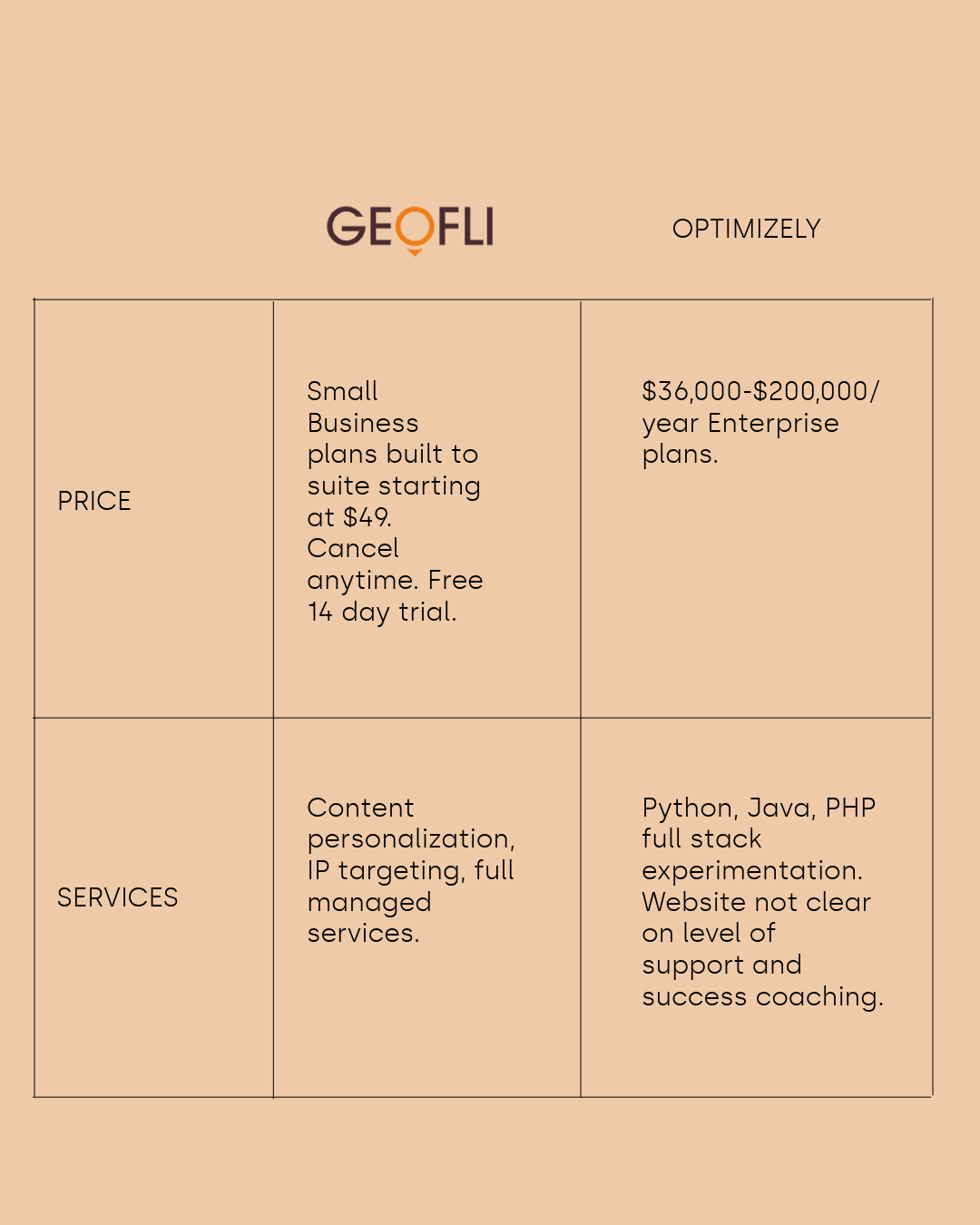
Optimizely is a full-stack experimentation platform. It supports Python, Java, and PHP environments, and it's designed for engineering-led organizations that want to run sophisticated A/B tests and personalization experiments across a complex digital ecosystem. The platform is capable, but it's priced and scoped accordingly.
GeoFli is built for marketing teams that want to personalize the website experience without writing code or managing a developer queue. The focus is on content personalization and IP-based geo-targeting, with fully managed services included. Plans start at $49 and are built to scale, with a free 14-day trial and no long-term commitment required.
What that looks like in practice
A marketing team running geo-targeted campaigns (sending visitors from Chicago to a version of the homepage that calls out Chicago, or adjusting the headline based on which ad they clicked) can set that up inside GeoFli in a few minutes. The same URL serves different experiences depending on where the visitor is coming from or what parameters are in the URL. No engineering work. No staging environment. No waiting. Message match between an ad and its landing page is one of the more reliable levers for improving conversion rates, and it's one that most campaigns leave untouched.
For an organization with a full development team, dedicated analytics infrastructure, and the budget to support a six-figure contract, Optimizely opens up more complex experimentation territory. Multivariate tests, server-side flags, and feature rollout capabilities that go well beyond what a marketing-focused tool needs to offer.
Who each tool is actually for
The gap between these two products isn't really about features. It's about the organizational stage and who's running point on the work.
If personalization decisions are being made by a marketing team or a small agency managing multiple clients, GeoFli fits the workflow. The setup happens inside the platform, the results show up on the website, and the managed services model means there's real support behind it. If personalization decisions are being made at the engineering level and are tied into a broader experimentation program, Optimizely is built for that kind of infrastructure. Gartner notes that most organizations overestimate how much technical complexity their personalization programs actually require.
Most companies don't start with a six-figure personalization contract. They start with a campaign, a hypothesis, and the need to see whether showing the right message to the right visitor actually moves the numbers. McKinsey's research on personalization shows that companies excelling at it generate 40 percent more revenue than average players. And that the gains tend to compound as personalization becomes more embedded in how a team operates. GeoFli is built for that starting point, and if you're working with an agency on paid media or organic strategy, layering in site personalization is a natural next step that closes the loop between the ad and the landing experience. CXL's landing page optimization research reinforces the same idea: the ad and the page need to tell the same story, and most campaigns still aren't doing that.
Schedule a demo to see what GeoFli looks like for your site.
Thank you! Your submission has been received!
Oops! Something went wrong while submitting the form.
You'll learn what happens in the seconds after a searcher clicks your ad, how Google grades the page they land on, and why matching that page to what they typed can lower your costs and bring in more leads.
You'll learn what a geo-targeted sticky banner does, why persistent placement outperforms static content, and how GeoFli lets you show the right message to the right visitor without touching your website's code.
GeoFli for Real Estate: One Website, Every Neighborhood
You'll learn how real estate agents and brokerages can use geotargeting to show buyers content built around the neighborhood they're actually searching in, without building a separate site for every zip code.